If you have just discovered that your child talks to strangers online, take a slow breath — by paying attention instead of panicking, you are already doing the most protective thing a parent can do. Here is the short answer: stay calm, do not punish your child for being found out (or for telling you), and get curious before you get strict. Ask gently what the conversations have been like, then look for the specific warning signs that separate an ordinary online chat from a genuinely unsafe one — secrecy, pressure, requests for photos or personal details, sudden gifts, or any push to meet in person or move to a private app. Block and report anyone who shows those signs. And above all, make sure your child knows the one rule that protects them for life: whenever something online feels strange or scary, they can always come to you, and they will never be in trouble for telling.
This guide is a companion to our broader walkthrough on how to talk to your child about online safety; here we zoom in on the specific worry so many parents of children ages 8–12 share — strangers.
Is it always dangerous if my child talks to strangers online?
No — and that distinction matters more than almost anything else in this article. For children ages 8–12, the internet is where a great deal of ordinary friendship now happens: gaming lobbies, group chats, comment threads, and communities built around a favourite show or hobby. Not every unfamiliar username belongs to someone who means harm, and treating each one as an emergency can quietly teach your child to hide the harmless ones from you.
What turns a stranger into a danger is not the simple fact that you have never met them. It is their behaviour. A person who chats about a game and then logs off is very different from one who asks your child to keep secrets. So the skill we want to build — in ourselves first, then in our children — is reading behaviour, not reacting to the word “stranger.”
What should I do first when I find out?
Your first reaction sets the tone for every conversation that follows, so lead with warmth and save the strictness for later. A calm order of operations:
- Steady yourself before you speak. Your child is watching your face to learn how frightened they should be.
- Open with warmth, not interrogation. Try: “I noticed you’ve been chatting with someone I don’t know. I’m not angry — I just want to understand. Tell me about them?”
- Never punish the honesty. If discovering an online chat means the device is seized and the door slammed, the lesson your child absorbs is simple and dangerous: don’t tell next time.
- Gather the facts gently. Who is it, how long has it gone on, what have they asked for, has any personal information or photo been shared, and has anyone suggested meeting or keeping a secret?
- Act on what you find. If you spot a warning sign, save the evidence with a screenshot, then block and report the account on the platform. If there was sexual pressure, a threat, an adult targeting your child, or a request to meet, treat it as a safety matter and contact your local authorities.
What are the warning signs that an online stranger is not safe?
Teach yourself these first, and later hand them to your child in plain words. Watch behaviour, not usernames:
- They ask for personal information — real name, school, address, birthday, or where your child will be.
- They ask your child for photos, or start sending their own.
- They push your child to keep the friendship secret from you.
- They offer compliments, gifts, game currency, or special attention very quickly.
- They try to move the chat to a private app where it is harder for you to see.
- They make your child feel guilty, pressured, or afraid to say no.
- They suggest meeting in person.
Any single one of these earns a pause and a closer look. Several together earn quick action. And if a stranger ever uses a photo, a secret, or a threat to control your child, the situation has crossed into something more serious — our calm, step-by-step guide on what to do if your child is being blackmailed online will walk you through exactly how to respond.
How do I talk to my kids about online strangers without scaring them?
The old warning — “don’t talk to strangers” — no longer fits a world where friendly strangers are one tap away and usually perfectly nice. Children quietly ignore rules that don’t match what they see every day. What works better for ages 8–12 is teaching them to notice red-flag behaviour and to trust the uneasy feeling in their stomach. Keep it small and frequent rather than one big, solemn talk:
- Name what’s private. Full name, address, school, passwords, plans, and photos: “These belong to our family, not to people we haven’t met in real life.”
- Give them permission to be “rude.” A safe grown-up never needs a child to hide things from their parents, so your child never owes an online stranger politeness.
- Practise the exit. “If someone makes you uncomfortable, you can stop replying and come get me. You don’t have to explain yourself to them first.”
- Make the promise, out loud and often. “If anyone online ever makes you feel weird, scared, or specially chosen for a secret, you can tell me anything — and you will not be in trouble.”
Say that last sentence until your child could finish it for you.
Why doesn’t “just don’t talk to strangers” work anymore?
Because it asks a child to switch off the very thing the internet is built to encourage: connection. The apps your child loves are designed to introduce them to new people, and most of those people are harmless. A blanket ban gives a child no way to tell the difference — so the first time a “nice” stranger comes along, the rule simply falls apart.
Monitoring software has its place, but it cannot make that judgement for your child, and it cannot be there in the one moment that matters — when a message arrives and your child has to decide what to do. What protects them then is not a filter; it is the judgement you have helped them build and the certainty that you are safe to come to. Software can support you. It cannot replace you.
How can a story help my child recognise an unsafe stranger?
Here is the quiet truth every parent eventually learns: a child rarely acts on a lecture in the heat of the moment, but they will act on a feeling they have already practised. That is exactly what a good story does. It lets a child rehearse a hard choice from the safety of your lap, so the real version feels familiar instead of frightening.
When a child has followed a character who felt the pull of a too-friendly stranger, noticed the warning signs, and chose to tell a trusted grown-up, they have already walked the path once. That rehearsal travels with them into rooms you cannot see. Our friend Lena meets these very tangles — the flattering message, the “don’t tell your mum” secret, the pressure dressed up as friendship — and finds her way to honesty and a grown-up who helps. Stories like hers give your child the words and the instincts long before they ever need them.
Want a simple way to start practising all of this together, beginning tonight? Tonight, try this: read one short story together, pause at the moment the character has to make a choice, and gently ask your child what they would do. Our collection of Lena stories for children ages 8–14 is built for exactly these conversations — each one ends with a simple question you can talk through together.
What is my gentle next step as a parent?
You will not get every conversation perfect, and you do not need to. Children are not kept safe by flawless parents; they are kept safe by present ones. Keep the door open, keep repeating the promise that they will never be in trouble for telling you, and keep talking in small, ordinary moments. A child who knows — deep down — that home is the safest place to bring a problem is a child who will bring you the problem while it is still small.
Frequently asked questions
At what age should I talk to my child about online strangers?
As soon as they use any device that lets them chat with other people. For younger children it is simply, “Tell me if someone you don’t know messages you.” For ages 8–12 it grows into noticing warning signs and protecting private information.
Should I install monitoring software on my child’s device?
It can be one helpful tool, especially in the early years, but it works best alongside open conversation — not instead of it. Trust and judgement protect a child in the moments an app cannot see.
My child already shared personal information with a stranger. What now?
Stay calm and thank them for being honest. Together, tighten their privacy settings, remove identifying details from their profile, block the account, and report it to the platform. If anything felt threatening, save the evidence and contact your local authorities.
What if the “stranger” is really just another kid?
Often it is — and that can still be worth a gentle look. Focus on behaviour: even a child their own age asking for secrets, photos, or private details is a reason to step in and set clearer rules.
📚 The story that walks your child through it
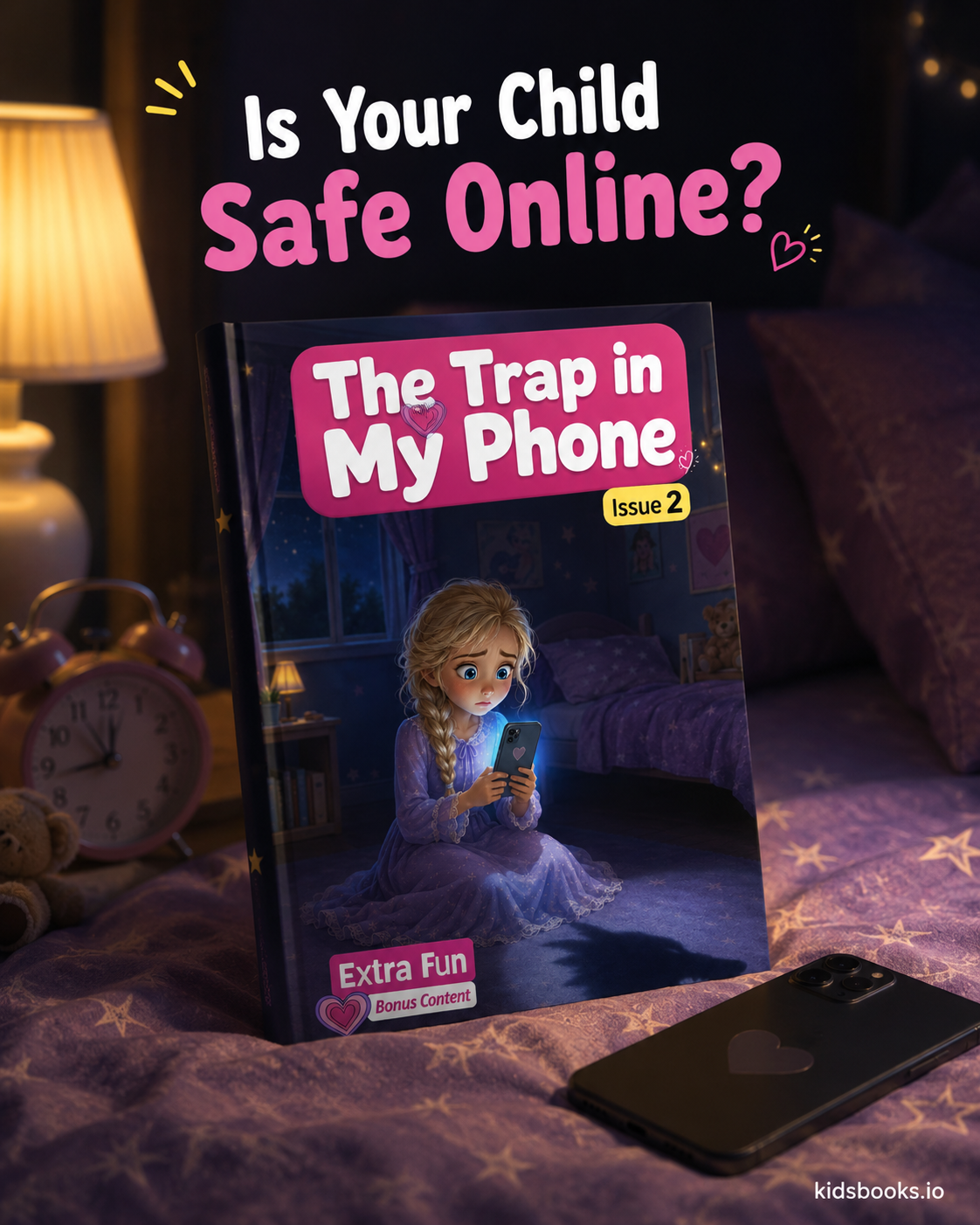
The Trap in My Phone — the story about a too-friendly online stranger, a secret that grows heavy, and asking for help, for ages 8–14. Part of the Lena series from the Lena moral-stories collection for ages 8–12.